By Ekemena Azaino
The former Chief of Defense Staff and Pro-Chancellor, Delta State University, Abraka, Gen. Alexander Ogomudia (Rtd) has admonished the Niger Deltans to look beyond oil to embrace accelerated development as natural resources alone do not guarantee development.

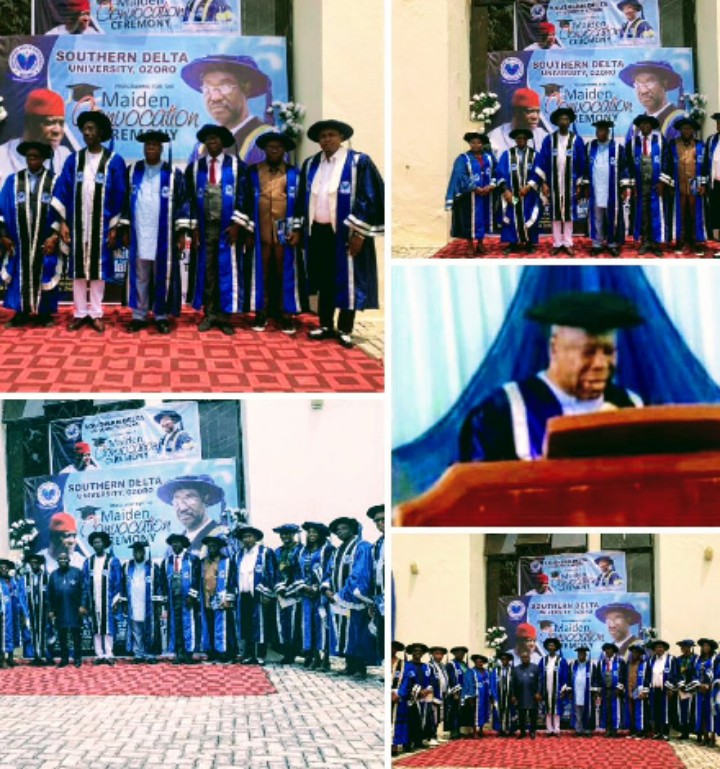
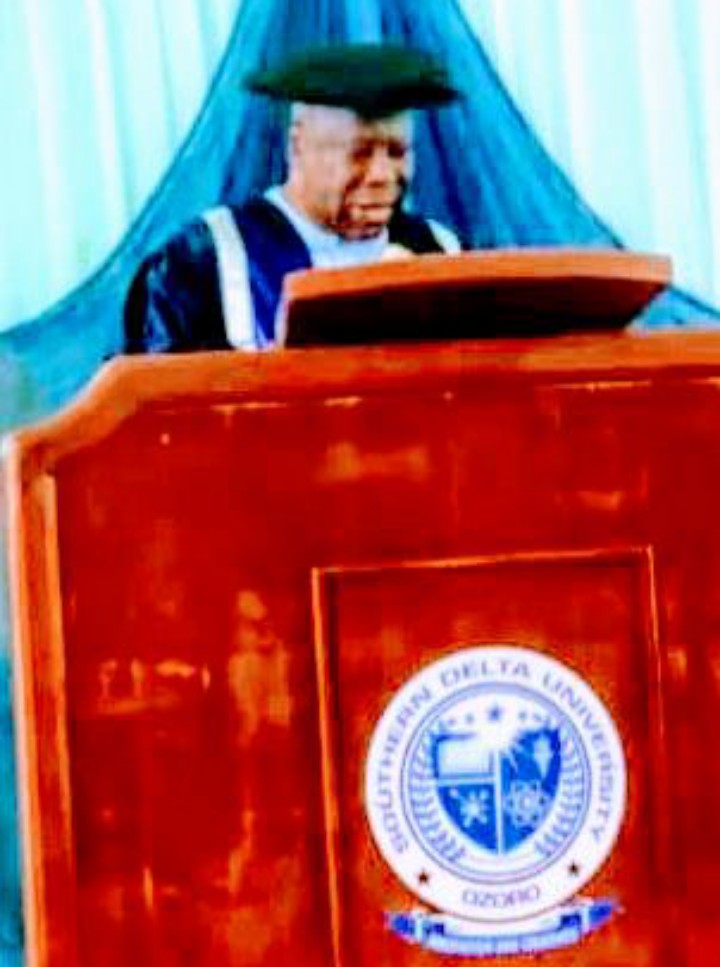 He made this admonition on Wednesday February 25, 2026 while delivering the Maiden Convocation Lecture of the Southern Delta University (SDU) Ozoro, titled “Beyond Oil: The University and the Future of the Niger Delta” at the University Auditorium, stressing that to attain a sustainable future for the Niger Delta, there must be economic planning reconnection with ecological regeneration, as the ecological abundance that once sustained the region has become increasingly fragile.
The General decried the reduction of the Niger Delta region to a single narrative of only oil despite it’s abundance and adversity, wealth and want irrespective of it’s contribution and contradiction, stressing that “This reduction obscures the complexity of a region whose geography, history and political economy have been shaped by both internal and external forces”
Gen. Ogomudia emphasized that the Niger Delta is more than oil being a landscape where ecology, history and politics intersect, noting that “what transforms resources into sustainable progress is knowledge, institutions, leadership, and human capital”.
He stated that “A sustainable future for the Niger Delta must reconnect economic planning with ecological regeneration”, emphasizing that sustainable development is only possible when Niger Delta reconnect economic planning with ecological regeneration with the availability of the prerequisite knowledge, established institutions, proactive leadership and qualified human capital.
According to him, “We now live in an era defined not by stability but by transition. The foundations upon which nations built their economies in the twentieth century are under the weight of technological disruption, environmental urgency and geographical realignment”.
The Pro-Chancellor stressed that “the future will no longer belong to those who own natural resources but those who acquire knowledge continuously, adapt rapidly and innovate intelligently”.
He further noted that “Regions, like the Niger Delta, rich in natural resources sometimes experience slower development, weaker institutions and heightened conflicts compared to less-endowed areas, arising from intensified competition over revenue, reshaped political incentives and fostered dependency on centralized allocations, adding that “Hence, by having a higher knowledge economy, there would be greater creativity, adaptability and problem-solvers in the region”.
He therefore charged universities to continuously evolve in order to adequately prepare students for future realities by enhancing interdisciplinary learning, critical thinking, digital fluency, research commercialization and community engagement to give them competitive advantage globally.
Furthermore, he implored the universities in the region to serve as anchors for stability amid uncertainty, provide evidence-based policy guidance for post-oil planning, incubate startups focused on renewable energy, environmental remediation, marine biotechnology and digital services.
Further to the delivery of the convocation lecture, Gen. Ogomudia also advocated for economic diversification in the Niger Delta which should be region-specific, evidence based and future-oriented, whereby universities must play the dominant role by developing pathways for agriculture and the blue economy, environmental restoration, technology, creativity and entrepreneurship.
He therefore charged the graduands of the institution to cultivate the exceptional qualities of competence, courage and character, challenging them to contribute meaningfully to the society that has invested in their education as professionals and to also act with integrity; as entrepreneurs who create sustainable enterprises; scientists who pursue solutions; educators who inspire critical thinking and public servants who prioritize the common good.